or share via social media

Air Quality
Strategic Communications
Air Pollution Across the Indo-Gangetic Plain and Himalayas: A Simplifying Science Media Campaign
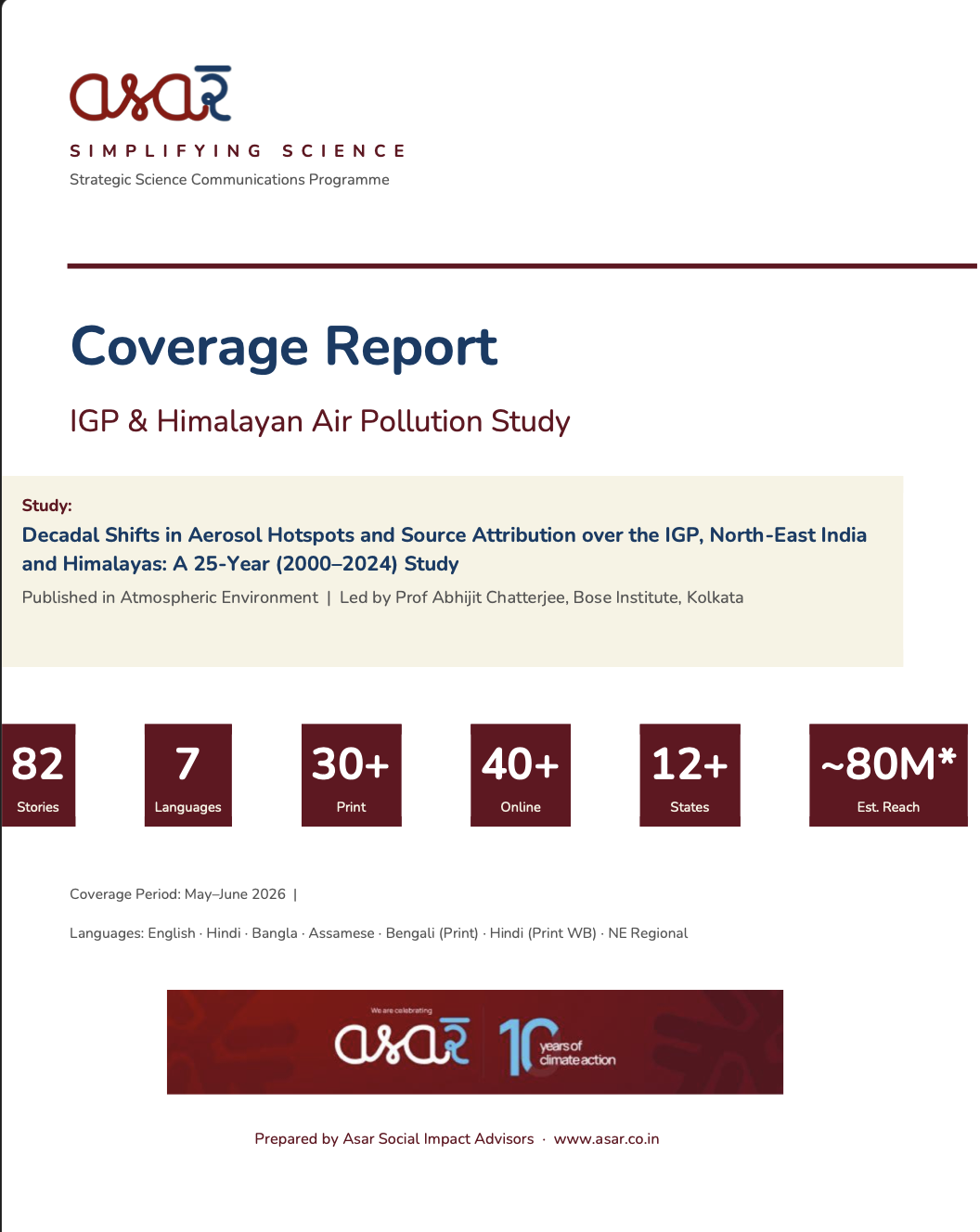
DownloadThis report documents the outreach and impact of Asar’s second campaign under the Simplifying Science programme. Centred on the study, Decadal Shifts in Aerosol Hotspots and Source Attribution over the IGP, North-East India and Himalayas: A 25-Year (2000–2024) Study, published in Atmospheric Environment, the campaign translated complex scientific findings into accessible, evidence-based stories for diverse audiences across India. The research was led by Prof. Abhijit Chatterjee of the Bose Institute, Kolkata, with Mr. Soumen Raul as the principal research fellow.
The study revealed that particulate matter pollution has increased by more than 20% across the Indo-Gangetic Plain, the Himalayan region and North-East India over the past two decades, with pollution from the plains increasingly affecting Himalayan ecosystems. It also highlighted the growing role of biomass burning in driving air pollution, particularly in North-East India, underscoring the need for stronger policy attention beyond urban emission sources.
Working closely with the research team, Asar developed region-specific press materials in multiple languages and disseminated them through an extensive network of media partners. The campaign generated more than 80 stories across 7 languages, reached audiences in 12+ states, secured coverage in over 30 print and 40 digital publications, and achieved an estimated audience reach of nearly 80 million people. This report captures the campaign’s methodology, media outreach and impact, demonstrating how strategic science communication can bridge the gap between research and public understanding.
Related Reports
Strategic Communications

Gender & Climate
Maharashtra
Designing A Gender Transformative Drought Early Warning System – Perspective of Women Farmers from Dharashiv, Maharashtra
View