or share via social media
Climate Education in India is Being Reduced to Awareness Messaging. What Can We Do About It?
Why is Climate Anxiety Causing Young People to Feel Powerless?

I work in the climate change space. My every day work revolves around trying to understand communities’ lived realities, how they cope with disruption and to look for ways to strengthen their resilience. But today I am writing not as a professional, but as a mother of a five-year-old.
I am raising our child in Gurugram in the National Capital Region of Delhi –– one of Haryana’s ‘most developed’ flashy urban jungle with tall buildings and malls, and not much else. While raising a young child in an urban setting with limited family support is challenging in itself, recurring climate-related disruptions have made his schooling journey even more difficult throughout the year.
Constant Disruptions to Academic Calendar
My child started playschool in 2024, and is now in the formal schooling system. Over the last two years, I have realised that climate changed-related school breaks are the new normal.
Let’s start with when the academic session begins, around March end. We start the session in beautiful spring (bordering on Summers) and within a couple of weeks, Summer heat takes over. April brings extreme heat conditions. In May 2026, Delhi NCR saw its warmest night in 14 years. Schools, which usually close in June, shut their doors in mid-May itself.
Summers in Gurugram are dry and intense. It is difficult to step out during the daytime and evenings are not much better. This summer, the heat was so relentless that I had to pull him out of his dance classes, and even the evenings, which once meant running around in the park with his friends, became too hot for him to step outside.
The Anxiety of School Pick-Ups During Monsoon
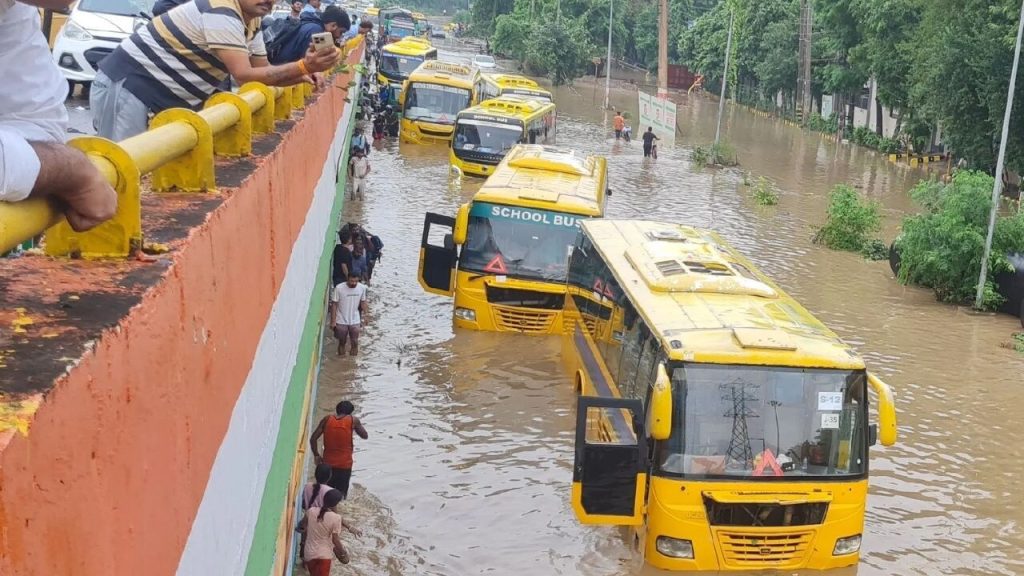
Come, July the schools reopened and soon enough monsoons caught up with us. Rains are not like before. We get intense spells of heavy rainfall which the Gurugram’s infrastructure is unable to cope with. One spell transforms the city into a water logged network of roads, where even driving a car is dangerous. Schools were forced to adjust as well. On heavy rain days we would get a message in the morning that the school bus will not operate today because of water logging, with parents being given the option to drop off their wards themselves if they wished. And I was left wondering, if a huge school bus cannot navigate the water logged roads, what chance did we have in our small hatchback? My child took leaves on those days.
On many days, schools would announce early dispersal due to heavy rain, waterlogging, or traffic disruptions, turning parents into emergency coordinators at short notice. While working from home gave me some flexibility, it often meant juggling meetings, tracking the school bus, coordinating pickups, and managing childcare all at once.
The anxiety was especially acute on days I was travelling. I still remember boarding a flight during a rainy morning, worried that an early-dispersal message might come while my phone was on flight mode. My last message to my partner was a reminder to keep checking the bus, and I spent most of the flight wondering whether my child had made it home safely. Thankfully, he had.
Now winters are here and the air quality has taken a dip. My little one is wearing a mask while commuting to school. The school is sending us emails on the measures they have taken to ensure air quality. But I am remembering last year when school closed early for winter vacations due to unbearable cold and extremely severe air quality. And I don’t know for how many days will the school be able to operate from school this year.
A ‘Normal Childhood’ Lost to Climate Change
It wasn’t always like this. I was born and brought up in Delhi. I have experienced its worst heat, rains and winters through the years. But never was the weather so extreme that our schools or colleges had to shut down, move to online teaching or shift the timing of vacations.
We had two months of summer vacation, now children get one month. That vacation is in June, which is possibly the most horrid hot and humid month of the year. My winter vacation coincided with Christmas break. But now children get winter vacations from 1-15 January, possibly accounting for extreme cold and the worst air quality. Rain never stopped our buses, or us splashing in the puddles. But now, we don’t know how deep one puddle is, and whether we would sink in it or stay afloat if we were to jump in one.
The past decade has made the worst impacts impossible to ignore. According to AQI (2026), Delhi’s climate has worsened sharply over the last 16 years, with more frequent extreme weather, which puts the city in the “Very High” severity category. Neighbouring NCR cities like Gurugram face much the same conditions. In 2025 alone, Delhi faced several crises at once: severe air pollution, with AQI levels above 400 according to CPCB data, heatwaves reaching 43.8°C, with real-feel temperatures above 47°C; and intense monsoon rains that left much of the city waterlogged.
School calendars have shifted, schools are facing unexpected and unpredictable closures during extreme times and left struggling to complete the syllabuses and learning outcomes for the children. They have to adapt their infrastructure, at least in the NCR, to the changing climate extremes. Air conditioning in summers, air purifiers in winters. Adequate indoor spaces for children for days when going out is not allowed. An added cost shifted to the parents through higher fees.
Saying No to Playing Outdoors Is Hurtful
Children’s well being is going for a toss. Going out to play in the evening was taken for granted in my childhood. But now, in peak summers even evenings have hot winds (loo) with a fear of falling sick, rains makes roads and parks inaccessible and winters’ air quality makes playing outside impossible.
Children are forced to grow in controlled environments, or take risks and fall sick. The number of times my child, who is healthy otherwise, falls sick is quite astonishing. My little one misses outdoors, his one persistent request is to go outside and play, a request I often have to deny.
I acknowledge the privilege with which I am able to bring up my child and am left deeply disturbed by how such coping mechanisms do not exist for a vast majority of the people around us. I had vowed to not let my child become a child who grows up in a bubble of air conditioning and closed spaces. But then again, the changing climate realities around me have defeated my resolve.
Be the first to hear about new initiatives, community voices, and grounded climate solutions.