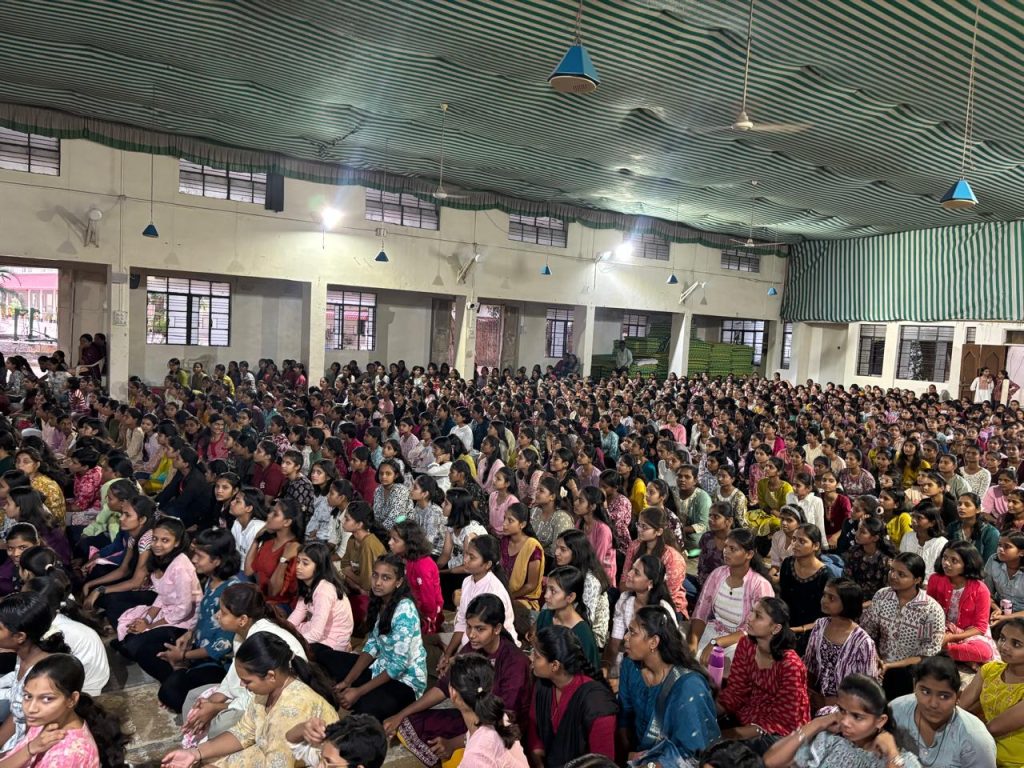
Imagine a school auditorium filled with nearly 800 girls between the ages of eight and 18. There is a palpable buzz in the air as they wait for a performance by a much-loved artist. The excitement is impossible to miss. They chatter animatedly with one another, their teachers, and anyone else who will listen, eager for the performance to begin.
The moment the artist steps onto the stage, the auditorium erupts into loud cheers and non-stop applause. We glance at our phone. Nearly five minutes have passed, yet the applause shows no sign of fading.
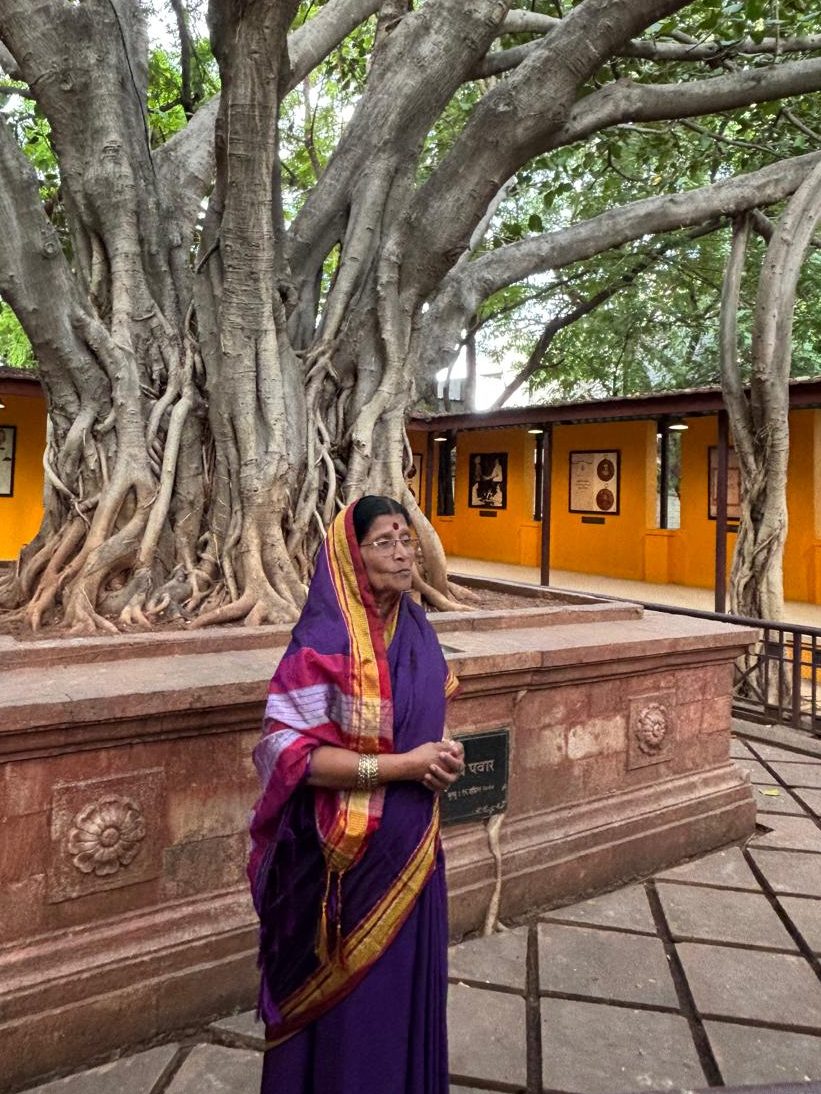
The artist is not a Bollywood icon or a pop culture celebrity. She is not on Instagram and doesn’t release singles. She is 76-year-old Chandatai Tiwari, one of Maharashtra’s most celebrated Bharud artists.
Chandatai Tiwari, one of Maharashtra’s most celebrated Bharud artists.
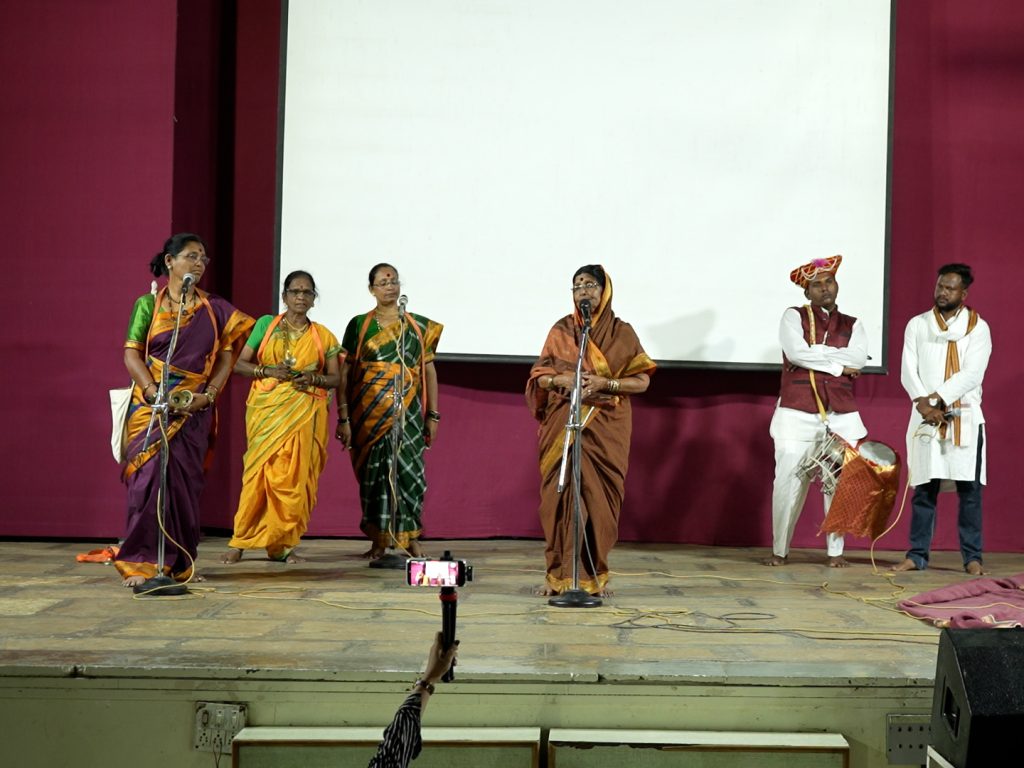
The chant ‘Dnyanoba Mauli Tukaram!’ erupts from the stage in perfect rhythm. In no time, 800 girls are singing and dancing in unison, completely engrossed. An atmosphere of devotion permeates the entire hall, centered around the 76-year-old. She jumps, dances, sings, with the energy of someone in their twenties.
We watched her perform, in quiet astonishment, at Sharada Niketan School in Baramati on the sidelines of the Pandharpur Wari. Tens and thousands of farmers from across Maharashtra undertake the pilgrimage by road every year, carrying the palkhi (palanquin) of Saint Tukaram, from Dehu and Pandharpur. The Wari has long carried messages of devotion, community and collective responsibility, through music and poetry, through bharuds and kirtans. Every year, during this very period, Chandatai visits this Sharada Vidyalaya.
But what unfolded over the next hour was more than a cultural performance.
Through songs, humour and storytelling, Chandatai spoke of the five elements of nature: earth, water, fire, air and space. She wove stories about changing rainfall, disappearing green cover and the need to protect the environment through the Bhaurd that she uses to convey bhakti. There were no alarming statistics or doomsday messaging.
Yet the attention of the audience never wavered. They watched intently, laughed, sang along and reflected.
A folk artist does not just reach an audience. They carry influence across generations and communities, performing in schools, village squares, festivals and pilgrimages where conversations continue long after the performance has ended.
Climate change was not what they read in textbooks anymore. For these students, it became a story of their lives and reality, told in a language they understood, by an artist they loved and admired. The school students were just a tip of the iceberg that is Chandatai’s audience. For anyone working in climate communication, the experience was a powerful reminder that facts alone rarely brings a sense of belonging and care. People connect first with stories, culture and trusted voices. Scientific evidence tells us what is happening, but folk artists like Chandatai help communities understand what those changes mean in their everyday lives.
That is precisely why folk traditions such as Bharud matter.
Rooted in the Bhakti movement and widely attributed to the 16th-century saint-poet Sant Eknath, Bharud blends music, poetry, drama and satire to communicate spiritual teachings alongside social messages. For centuries, it has helped communities question injustice, reflect on social change and make sense of complex issues through humour, emotion and shared cultural memory.
Today, that same tradition is proving equally powerful in helping people understand one of the defining challenges of our time: climate change.
Artists like Chandatai are not simply preserving a centuries-old cultural tradition. They are expanding its purpose. For more than four decades, she has used Bharud to engage communities on issues ranging from women’s health and family planning to education and social reform. Climate change is the latest issue to find a place in her repertoire, not because it is fashionable, but because it is increasingly shaping the lives of the very communities she performs for.
This is the thinking behind the Climate Culture Collective, an initiative by Asar that brings together folk artists, storytellers and cultural practitioners to make climate conversations more rooted, relatable and locally meaningful. Rather than asking communities to engage with unfamiliar scientific language, the Collective works with artists who already command trust and cultural legitimacy, equipping them with climate knowledge while allowing them the creative freedom to interpret it through their own traditions, languages and lived experiences.
Earlier in the day, as thousands of warkaris were passing through Baramati, Chandatai’s daughter Sandhya Sakhi, a Bharud poet herself, took to an erected stage and performed about the various pollutants and the impact air, water, and plastic pollution has on our health. The warkaris, stopped their walk, and watched her performance – an audience that pollution reports would have never reached. On the sidelines, the BaiManus Media Research Foundation’s team of college students enacted a street play on water scarcity and heat stress. The crowd of hundreds which had gathered to watch Sakhi’s performance, also stayed to watch the students’ play.
In a world where climate communication often struggles to move beyond data, empowering folk artists may be one of the most powerful ways to bridge the gap between science and communities.
A folk artist does not just reach an audience. They carry influence across generations and communities, performing in schools, village squares, festivals and pilgrimages where conversations continue long after the performance has ended. Their stories travel where reports cannot. Their songs are remembered long after decks are forgotten.
In a world where climate communication often struggles to move beyond data, empowering folk artists may be one of the most powerful ways to bridge the gap between science and communities.
Climate action depends not only on evidence, but also on emotion, identity, trust and belonging. When artists like Chandatai tell climate stories through traditions that communities have cherished for centuries, climate change ceases to be a distant scientific problem. It becomes a shared cultural conversation and, ultimately, a collective responsibility.