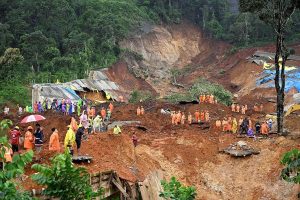
Governments have little choice but to spend money on relief measures when climate disaster strikes. In this piece, I analyze Tamil Nadu’s Revised Budget Estimates and Agriculture Budget – presented earlier this month – to illustrate how the state is trying to move beyond merely responding to disasters.
The state’s budget shows spending across three levels: responding to immediate climate shocks (reactive), reducing future vulnerability (preventive) and changing some of the systems that produce emissions and risk (transformative). These distinctions are important.
For one, spending money to manage the outcomes of a particular disaster does not make citizens less vulnerable to subsequent disasters. Secondly, building resilience requires upgrading infrastructures of energy, transport and trade that are responsible for the climate crisis. And thirdly, transitioning to cleaner technologies may adversely impact workers and communities.
The state’s newly-elected Tamilaga Vettri Kazhagam government’s largest investments are directed towards infrastructure for energy transition, but there are concerns about implementation, ecological outcomes and the real beneficiaries of these investments.
Scenario 1: Reactive Governance (pays for damages)
The most immediate climate-related spending in the budget is directed at managing the worst outcomes of bad weather. Tamil Nadu has allocated Rs. 340 crore from the State Disaster Management Fund to secure drinking water and cattle fodder during dry spells, and the implementation of the Tamil Nadu Agricultural University’s District Agricultural Contingency Plan across 12 districts affected by weather anomalies.
A separate Rs. 111 crore project, with Rs. 55 crore in initial funding, will implement drought interventions in 75 villages in Virudhunagar, Ramanathapuram and Sivagangai districts. Rs. 331.17 crore has been allocated for crop damage compensation and the Uzhavar Pathukappu Thittam, a social security scheme for elderly farmers and agricultural workers in Tamil Nadu.
Several other climate responses are also focused on agriculture:
- Rs. 134.83 crore for the Kuruvai Package Scheme, including support for direct seeding, liquid bio-fertilisers and seeds after a weak southwest monsoon and delays in releasing water from the Mettur Dam.
- Rs. 648.55 crore for crop insurance, covering 36 lakh acres across 37 districts against weather-related yield losses.
- Rs. 31 crore for the Kaalnadaigal Kaappom livestock insurance scheme, alongside more than Rs. 120 crore to upgrade veterinary hospitals and expand mobile services.
These allocations show the growing cost of creating safety nets for people whose lives and livelihoods are affected by climate change. The funds reach their homes and farms after a crisis has already reared its head.
Scenario 2: Preventive Governance (builds resilience before the next disaster)
In comparison to Scenario 1, more funds have been allocated for reducing climate vulnerability. Along Tamil Nadu’s coast, the budget allocates Rs. 322 crore for the TN-SHORE project, including Rs. 40 crore to restore 2,500 hectares of mangroves across eight coastal districts. Mangroves provide protection against coastal erosion and cyclonic impacts while storing carbon and fostering biodiversity. This is preferable to concrete sea walls.
In cities, Rs. 2,117 crore has been allocated for the Chief Minister’s Integrated Urban Development Mission. The budget’s focus on Chennai includes blue-green infrastructure, strengthening retaining walls and improving discharge capacity around water bodies.
The challenge, however, is not simply to move more water out of cities. Preventing urban flooding hinges on the protection of wetlands and land use reform.
The budget details other smaller investments in ecological systems:
- Rs. 25 crore for feasibility studies on reducing sewage and industrial pollution in the Cauvery, Vaigai and Tamiraparani rivers.
- Rs. 20 crore for studies on ecological restoration and barrages in the Cauvery delta.
- Rs. 122.51 crore for the Tamil Nadu Soil Fertility Mission in 2026-27, including support for green manure, multi-grain seeds, Soil Health Cards, vermicompost and liquid bio-fertilisers.
- Rs. 7.35 crore for crop protection and ecological restoration measures, including eco-friendly wild boar repellent, solar-powered fencing and the removal of invasive Prosopis juliflora.
- Rs. 4,025.63 crore for canal restoration and Rs. 125 crore for desilting 5,955 kilometres of rivers and canals.
- Rs. 785 crore for micro-irrigation, covering 2,22,794 acres through drip and sprinkler systems.
- Funding for 500 new farm ponds and the desilting of 500 existing ponds.
- Rs. 10 crore for tarpaulins for 43,500 farmers, protecting harvested crops from unseasonal rain.
Instead of disaster relief, these expenditures focus on soils, water systems, coastal ecosystems and farm-level infrastructure to minimise exposure to climate change related shocks. As with Scenario 1, there is still the question of follow-through and scale. Several river-related interventions are still at the feasibility-study stage. These need to pave the way for actual restoration and pollution-control, in future budgets.
Scenario 3: Transformative Governance (systemic decarbonisation and social equity)
The most substantial allocations in the budgets are towards transformative governance: changing how energy is produced and moved, how people travel, how industries operate, how livelihoods are protected etc.
A just transition for workers
One of the smaller allocations is also one of the more interesting. Rs. 3 crore has been allocated to train 12,500 traditional internal combustion engine mechanics in electric vehicle and battery maintenance.
The amount is modest, but the principle is significant. An energy transition can disrupt livelihoods if workers whose skills are tied to fossil-fuel technologies are left behind. Training existing mechanics for electric mobility acknowledges that decarbonisation is also a question of employment and economic security.
Preparing the grid for renewable energy
The largest transformative investments are in electricity infrastructure. Tamil Nadu is accelerating investments to meet projected peak power demand of 37,000 MW by 2035-36.
Major projects include:
- The Coimbatore-Ariyalur transmission line: Rs. 4,000 crore.
- The Virudhunagar-Coimbatore transmission line: Rs. 1,640 crore.
- Chennai ultra-high-voltage grid upgrades: Rs. 1,390 crore.
- Green Energy Corridor Phase II: Rs. 1,187 crore.
- Green Energy Corridor Phase III: Rs. 6,884 crore.
- The Vellimalai Pumped Storage project: Rs. 5,050 crore.
The state is also drafting a Battery Energy Storage Systems policy. These investments recognise a basic challenge of the energy transition: adding renewable generation is not enough if the transmission grid and storage systems cannot manage it.
Cleaner transport and access to new technology
The budget allocates Rs. 500 crore to prepare depots for 1,000 new air-conditioned electric buses in Chennai. It also includes Rs. 50 crore for 20,000 public EV charging stations and Rs. 5 crore to support charging infrastructure in residential apartment complexes.
For solar energy, the budget provides Rs. 23.06 crore for standalone solar-powered pumpsets for 1,000 off-grid farmers and Rs. 50 crore as a top-up to the PM Surya Ghar scheme, supporting domestic consumers to install rooftop solar.
These measures could reduce dependence on fossil fuels. But access remains an important equity question. Who can afford an electric vehicle, install rooftop solar or benefit from new charging infrastructure? Public transport, agricultural energy and targeted subsidies may therefore matter as much as technology deployment itself.
Agriculture, ecology and low-carbon livelihoods
The transformative approach also extends to agriculture and rural livelihoods. The budget includes Rs. 16 crore for the Tamil Nadu Palmyra Development Corporation, Rs. 63.81 crore for the Tamil Nadu Millet Mission and Rs. 7.61 crore for the Minor Millet Mission. It allocates Rs. 60 crore for a Green Steel Production Initiative to support MSME steel rolling mills in adopting cleaner technologies.
Other allocations include:
- Rs. 4 crore for the Vetri Vaanmagal Drone Force, including training for women drone operators and subsidies for trained women.
- Rs. 60 lakh for demonstrations of Direct Seeded Rice and Alternate Wetting and Drying across 2,000 acres, alongside work on carbon trading verification protocols.
- Rs. 1,531.38 crore in forestry-related allocations, including support for agroforestry and human-animal conflict management.
- Rs. 17.70 crore for an Agroforestry Scheme covering 12,500 acres of fallow land.
- 35.51 lakh tree seedlings for farms under the Green Tamil Nadu Mission.
- Rs. 8 crore in organic farming incentives and funding towards the proposed Nammalvar Diploma College for Organic Agriculture.
- Rs. 1 crore for research at Sandiyur KVK in Salem on converting poultry waste into organic fertiliser pellets.
Tamil Nadu is spending roughly Rs. 1,700 crore on responding to immediate climate-related shocks and around Rs. 7,600 crore on preventive resilience. The largest share, nearly Rs. 19,000 crore, is directed towards longer-term systemic change, particularly electricity infrastructure, renewable energy integration and transport electrification. With total estimated revenue and capital expenditure of approximately Rs. 4.62 lakh crore in 2026-27, these climate-linked allocations account for roughly 6% of the state budget.
The categorisation is not exact. Many budget allocations serve multiple purposes, and not every rupee spent on a transmission line, canal or urban infrastructure project should automatically be counted as climate spending.
The key question is whether these investments reduce vulnerability. Will restored mangroves strengthen protection for coastal communities? Will urban flood infrastructure benefit the neighbourhoods most exposed to extreme rainfall? Will workers be able to find secure livelihoods as older industries change? Will ecological studies lead to long-term restoration? And who will have a say in deciding how this transition unfolds?