or share via social media

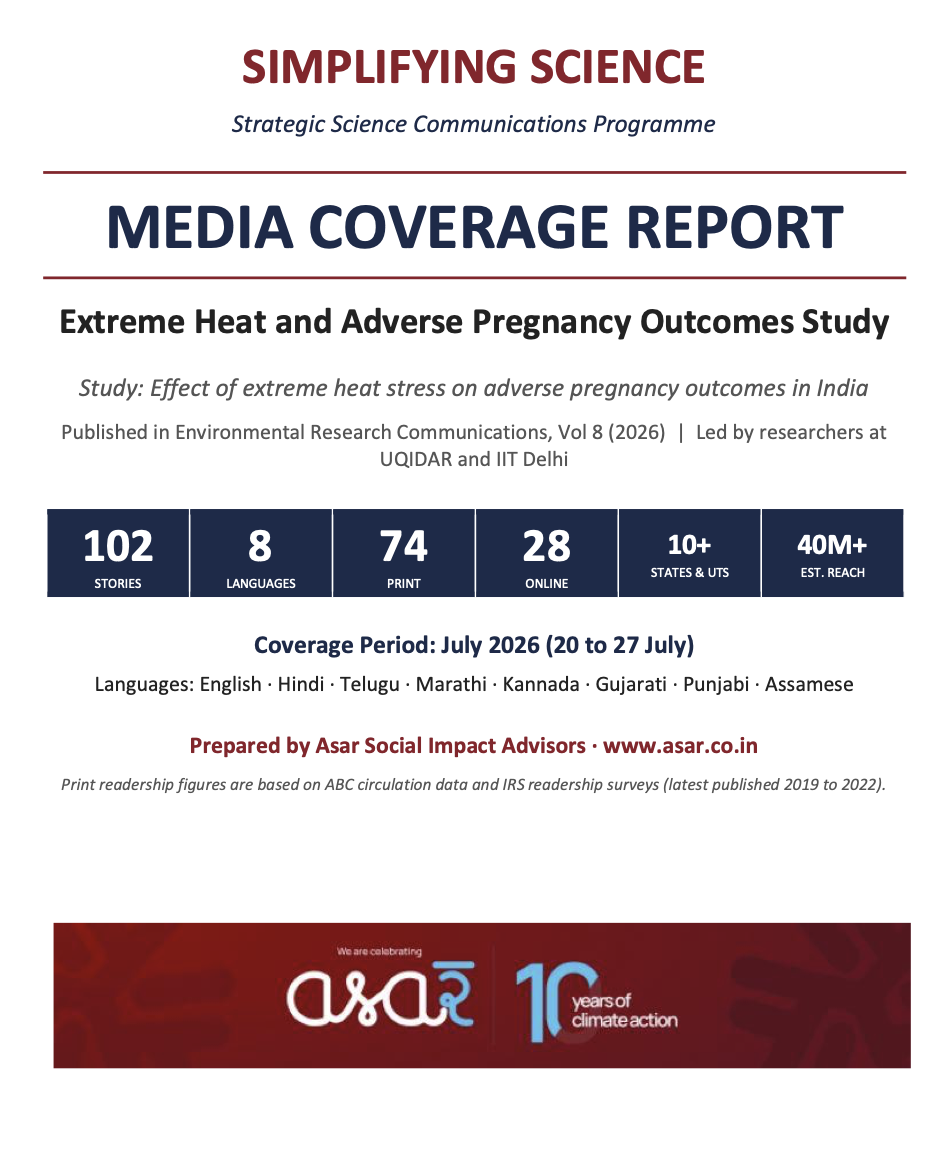
As part of the Simplifying Science programme, Asar partnered with researchers to communicate the findings of the study, “Effect of extreme heat stress on adverse pregnancy outcomes in India,” published in Environmental Research Communications (Vol. 8, 2026). Led by Vineetha Vincent of the University of Queensland and IIT Delhi Academy of Research (UQIDAR), alongside Darsy Darssan, Nicholas J. Osborne and Sagnik Dey, the research drew on collaborations between IIT Delhi, the University of Queensland, UNSW Sydney, the University of Exeter and Korea University. Analysing 209,266 births across 707 districts in India, the study found that even short periods of extreme heat during pregnancy were associated with higher risks of low birth weight and preterm birth, with the greatest impacts on socioeconomically vulnerable women and those living in mountainous regions.
To ensure these findings reached diverse audiences, Asar designed a multilingual, region-specific media outreach strategy that translated the research into accessible stories tailored to different geographies. The campaign generated 102 stories across eight languages, with coverage spanning more than 10 states and union territories through national, regional and vernacular media. Despite unfolding during one of the year’s most crowded news cycles, the campaign demonstrated how strategic science communication can help rigorous research break through, making complex evidence relevant and accessible to journalists, policymakers and the wider public.
Related Reports
Air Quality
Strategic Communications
Strategic Communications
Moist Heatwaves, Monsoons and Public Awareness: A Simplifying Science Media Campaign
View