Micro, Small and Medium Enterprises (MSMEs) are integral to West Bengal’s industrial economy, contributing substantially to employment, exports, and local livelihoods. Within this sector, micro-enterprises account for nearly 99% of all MSMEs in the state and are often concentrated in geographically defined clusters that share resources, production ecosystems, and markets. While these clusters sustain economic activity and heritage craftsmanship, they also face growing challenges of high energy costs, dependence on fossil fuels, and inefficient outdated technologies.
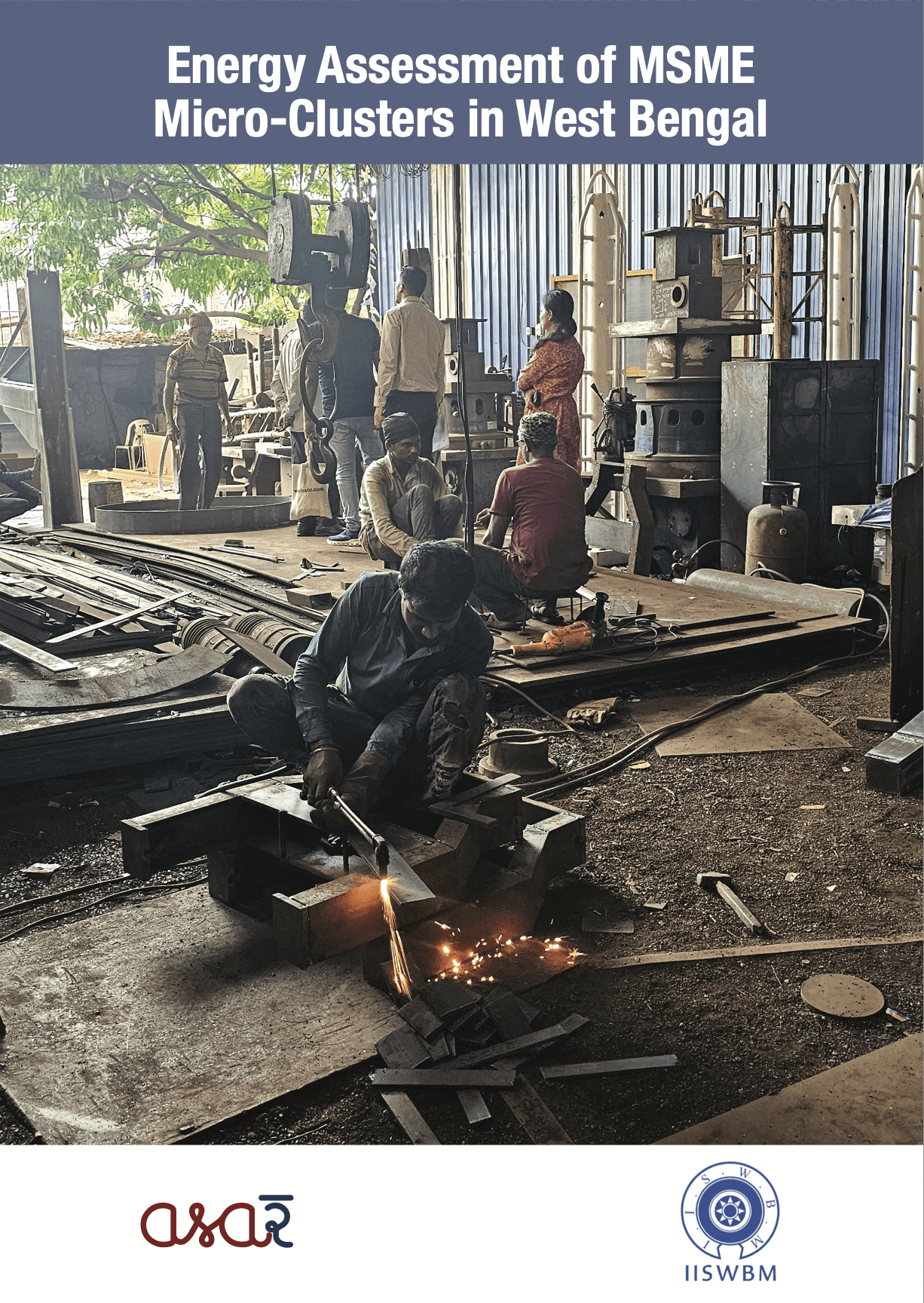
This energy assessment aims to understand how micro-enterprises in selected clusters across West Bengal use energy, where inefficiencies exist, and what practical steps can help reduce emissions while improving overall productivity and competitiveness. Asar, in partnership with the Indian Institute of Social Welfare and Business Management (IISWBM), has launched this initiative to assess energy consumption patterns, identify cost and efficiency bottlenecks, and recommend actionable strategies to support businesses in enhancing sustainability and profitability by adopting cost-effective, cleaner, and more efficient practices. Howrah district, along with an adjoining district-South 24 Parganas, was selected owing to its high concentration of clusters of micro enterprises, the presence of diverse sub-sectors relevant to the study, and the ease of conducting detailed energy assessments within the available time and resources. Furthermore, the study assessed 15 units across galvanising, engineering, wire drawing, and silver filigree sub sectors.
The targeted sub sectors — silver filigree in South 24 Parganas and galvanising, wire drawing, and engineering units in Howrah — represent significant sectors of West Bengal’s informal and small-scale industrial ecosystem. These units are deeply embedded in the state’s industrial heritage and provide critical employment and livelihood opportunities. However, their high reliance on fossil fuels, inefficient equipment, and skill constraints pose sustainability challenges.
Strategic Role of Micro-clusters in Decarbonisation
Given their density and shared characteristics, micro-clusters present an efficient point of intervention for promoting energy efficiency and cleaner production technologies. By targeting specific sub sectors, decarbonization efforts can achieve economies of scale, foster peer learning, and align with existing local governance or industry bodies. This approach also ensures that interventions are technically feasible, and economically viable for the units in the micro clusters. By focusing on units such as those in Howrah and South 24 Parganas, this study aims to demonstrate how decentralised energy assessments can feed into broader policy, financial, and skill development ecosystems to enable a low-carbon MSME transition.
In the case of silver filigree enterprises in South 24 Parganas are not only a significant cultural cluster-anchored in centuries-old artisanal traditions and heritage craft but also a high energy-consuming sector, where small changes — like improved heating methods or fuel substitution can result in measurable cost savings and emission reductions.
Key findings and recommendations
The energy assessment of selected micro-clusters shows clear patterns in how energy is used and where bottlenecks exist. Many units continue to run on outdated and inefficient machinery, such as coal-fired furnaces in silver filigree or fuel-oil systems in galvanising, while engineering and wire drawing units rely heavily on electricity-intensive motors. These practices keep operating costs high and reduce competitiveness.
At the same time, the assessment found practical opportunities for savings across the units, 3–5 low-cost interventions ranging from improved insulation and efficient burners to fuel substitution were identified that could deliver measurable gains. However, gaps in technical skills and limited awareness restrict the ability of micro enterprises to adopt these solutions or make full use of existing facilities like Common Facility Centres.