Popup Image

Share this powerful gallery of art and climate.

These paintings speak of survival, resistance, and care. Share this page with those who value community, creativity, and climate justice.

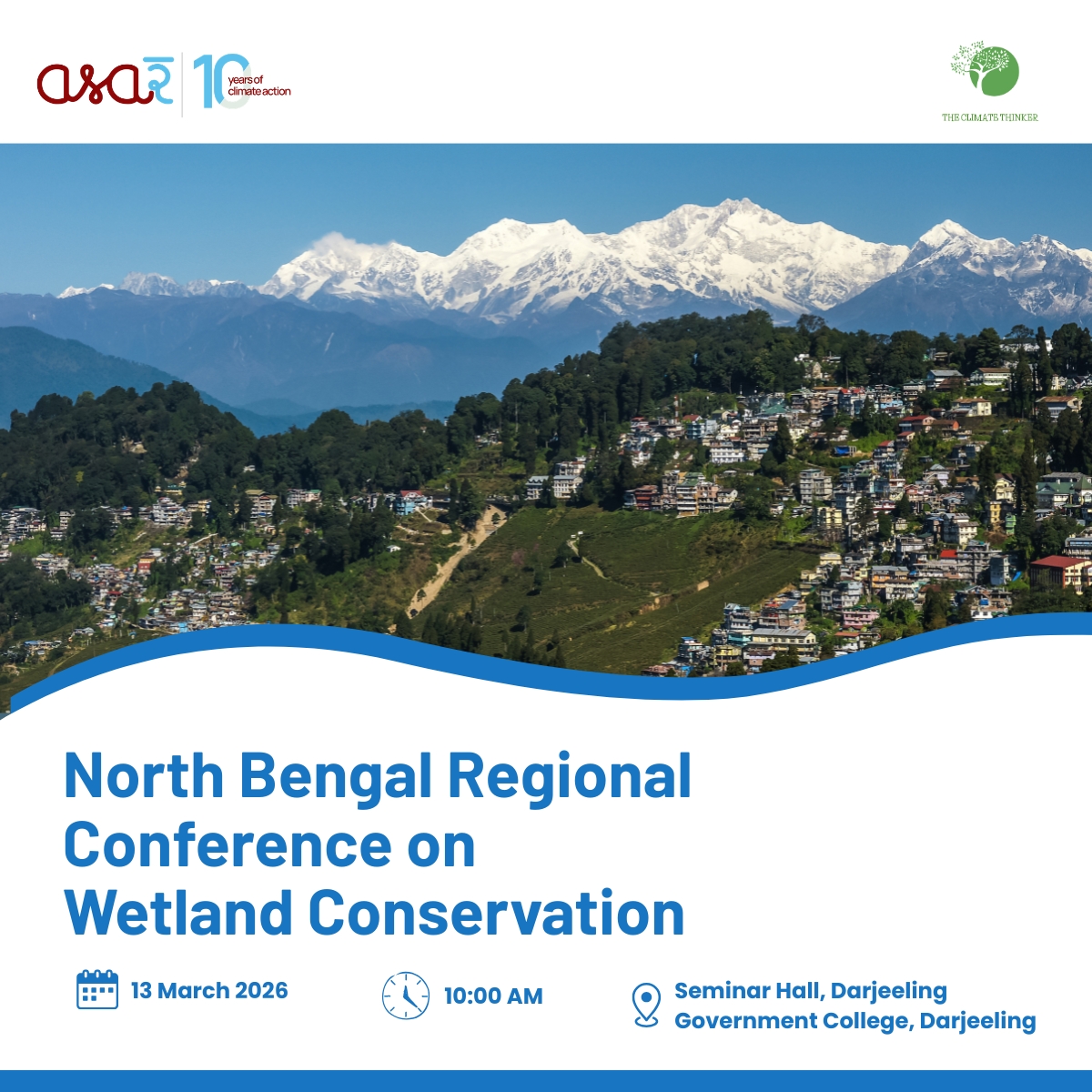
North Bengal Regional Conference on Wetland Conservation

We are pleased to invite you to the North Bengal Regional Conference on Wetland Conservation, taking place on 13 March 2026 from 10:00 AM onwards at the Seminar Hall, Darjeeling Government College, Darjeeling.

This regional gathering will highlight the ecological importance of wetlands across North Bengal while addressing the growing environmental challenges that threaten these fragile ecosystems.

The conference will bring together researchers, students, civil society organisations, policymakers, and local stakeholders to exchange ideas and perspectives on wetland conservation, biodiversity protection, and climate resilience. Through presentations, discussions, and shared field experiences, participants will explore collaborative approaches to strengthening wetland protection and sustainable management.

By creating a space for knowledge sharing and community dialogue, the conference aims to encourage practical solutions and collective action to safeguard the wetlands and biodiversity of North Bengal for future generations.

Kolkata Climate Fest 2026

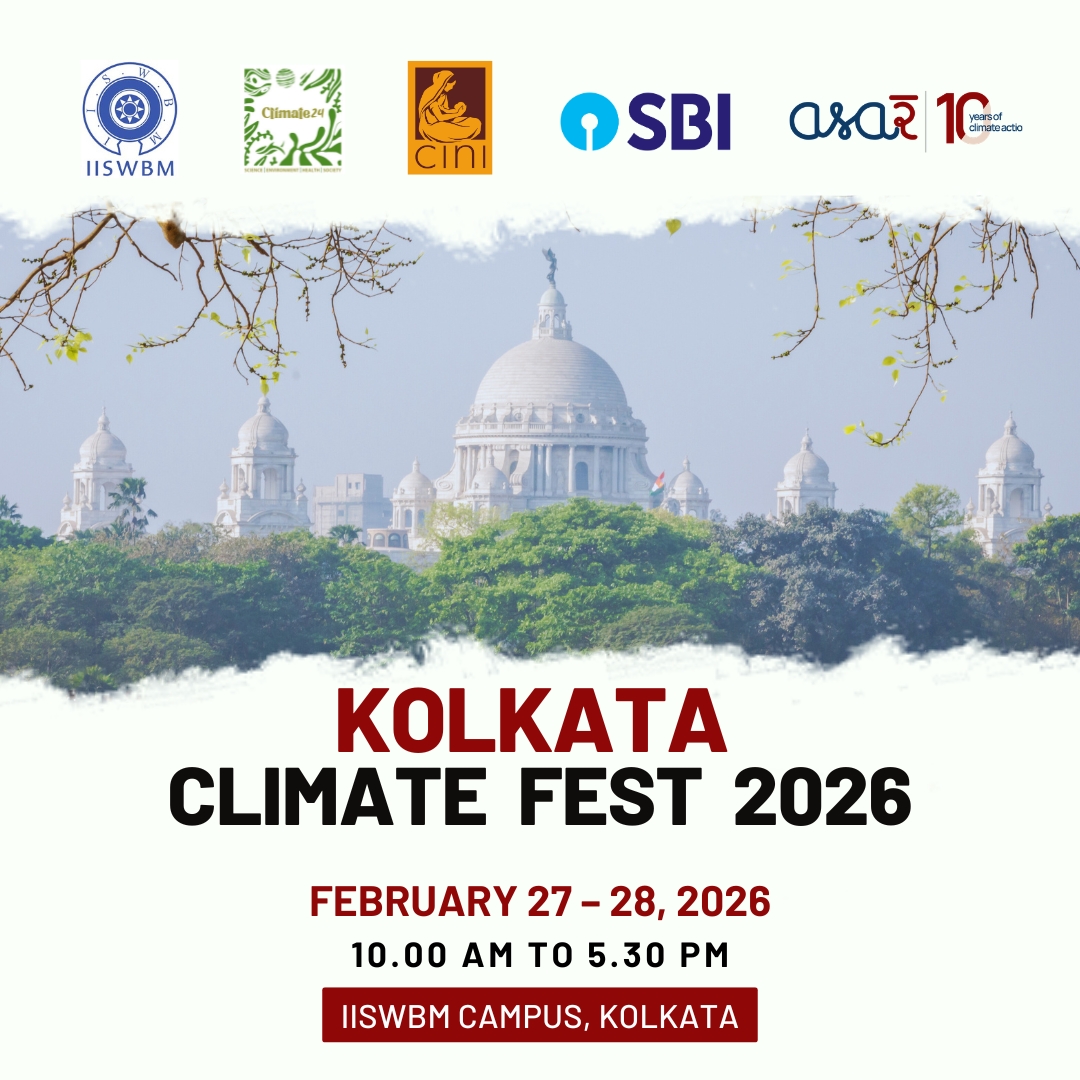
Kolkata Climate Fest 2026 is a first-of-its-kind academic climate platform that reimagines a “fest” as a space for dialogue, learning, and collective action. Organised by IISWBM in collaboration with Climate24 and Asar, the two-day event (27–28 February 2026) brings together policymakers, researchers, journalists, CSR leaders, students, and civil society to engage with urgent climate challenges shaping West Bengal and beyond.

The fest features thematic sessions on community-led climate governance, climate and public health, sustainability and net-zero transitions, financial inclusion, environmental reportage, and the intersections of climate with rivers, wildlife, and vulnerable communities. Keynotes, expert panels, and roundtables are complemented by interactive townhalls, exhibitions, and storytelling sessions that centre lived experiences of climate vulnerability, especially among children and grassroots communities.

With participation from academic institutions, think tanks, WHO experts, media professionals, and industry representatives, the event places students and institutions at the heart of climate discourse. By fostering multi-stakeholder collaboration and showcasing practical solutions, Kolkata Climate Fest 2026 aims to mainstream climate conversations, encourage informed action, and build a more inclusive and grounded climate movement in the region.

In essence, it is less a conventional conference and more a living ecosystem of ideas, where science, policy, community knowledge, and youth energy cross-pollinate into actionable climate pathways.

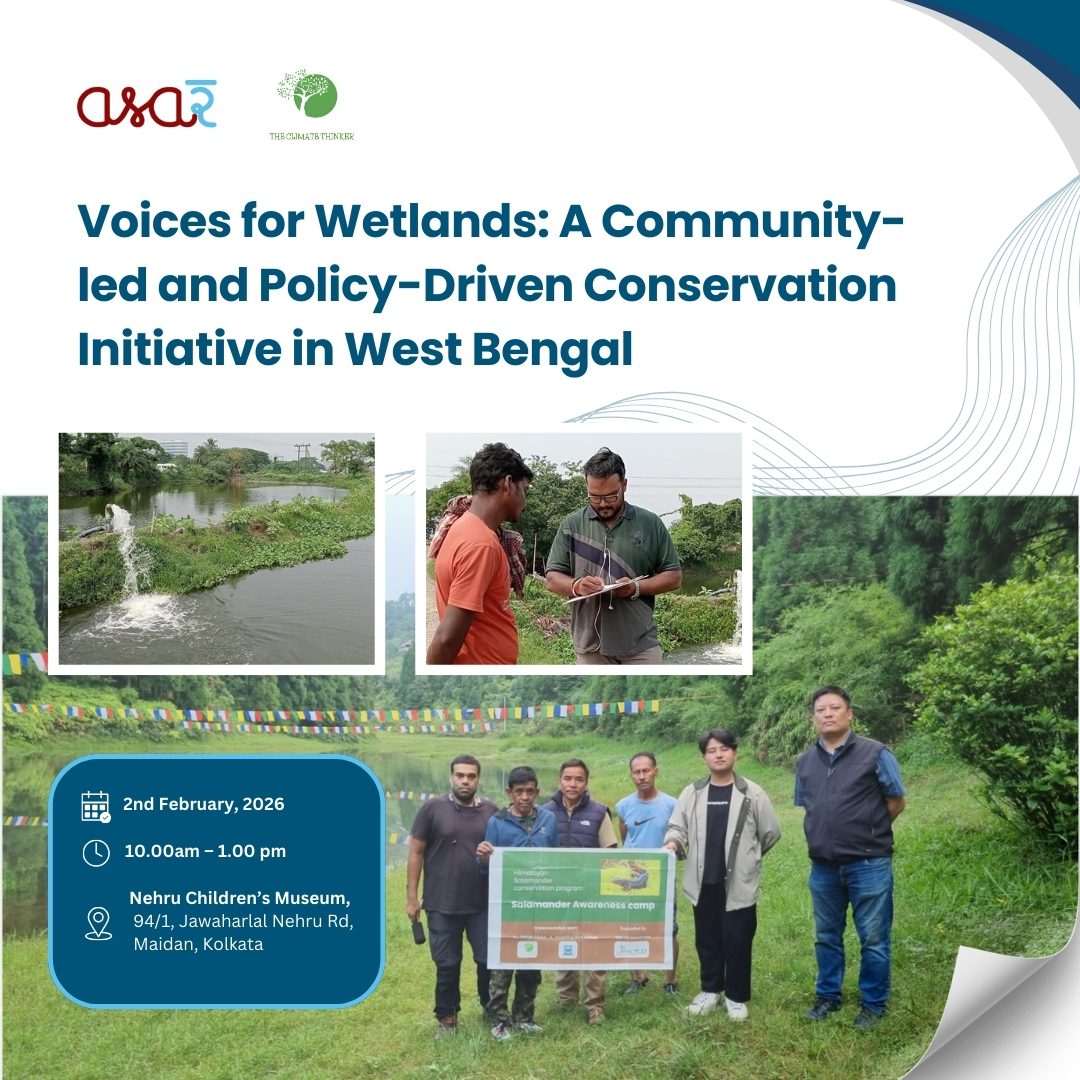
Voices for Wetlands: Launching a Community-led Digital Knowledge Platform

Wetlands are among West Bengal’s most vital yet most vulnerable ecosystems. From the East Kolkata Wetlands and the Sundarbans to countless riverside floodplains, marshes, and village ponds, they support biodiversity, livelihoods, food systems, and climate resilience. Yet, despite their importance, wetlands across the state continue to face growing pressure from unplanned urbanisation, pollution, encroachment, climate change, and complex institutional coordinaton.

Voices for Wetlands emerges as a response to this challenge, grounded in a simple but powerful idea: wetland conservation can only be effective when communities who depend on these ecosystems are active partners. The initiative attempts to integrate community knowledge, bridge gaps between research and practice, and foster dialogue between local custodians, educators, civil society organisations, and policymakers.

As the first milestone of this initiative, The Climate Thinker, in collaboration with Asar Social Impact Advisors, will launch a Digital Wetland Knowledge and Community Platform on 2 February 2026 in Kolkata. Designed as a living, participatory space, the platform will document wetlands across West Bengal through maps, stories, photographs, and field insights; archive community knowledge and traditional practices; share research and policy-relevant resources in accessible formats; and connect diverse stakeholders working on wetland conservation.

The launch event is structured as a listening and dialogue-oriented gathering rather than a ceremonial programme. It will bring together community representatives from wetland- dependent regions, educators, researchers, civil society actors, and government officials. The programme will feature reflections from community members, perspectives from educators and researchers, and a panel discussion focused on aligning ecological conservation with social and economic realities.

This event hopes to initiate a sustained engagement process aimed at advancing inclusive, evidence-informed, and conflict-sensitive approaches to wetland conservation in West Bengal.
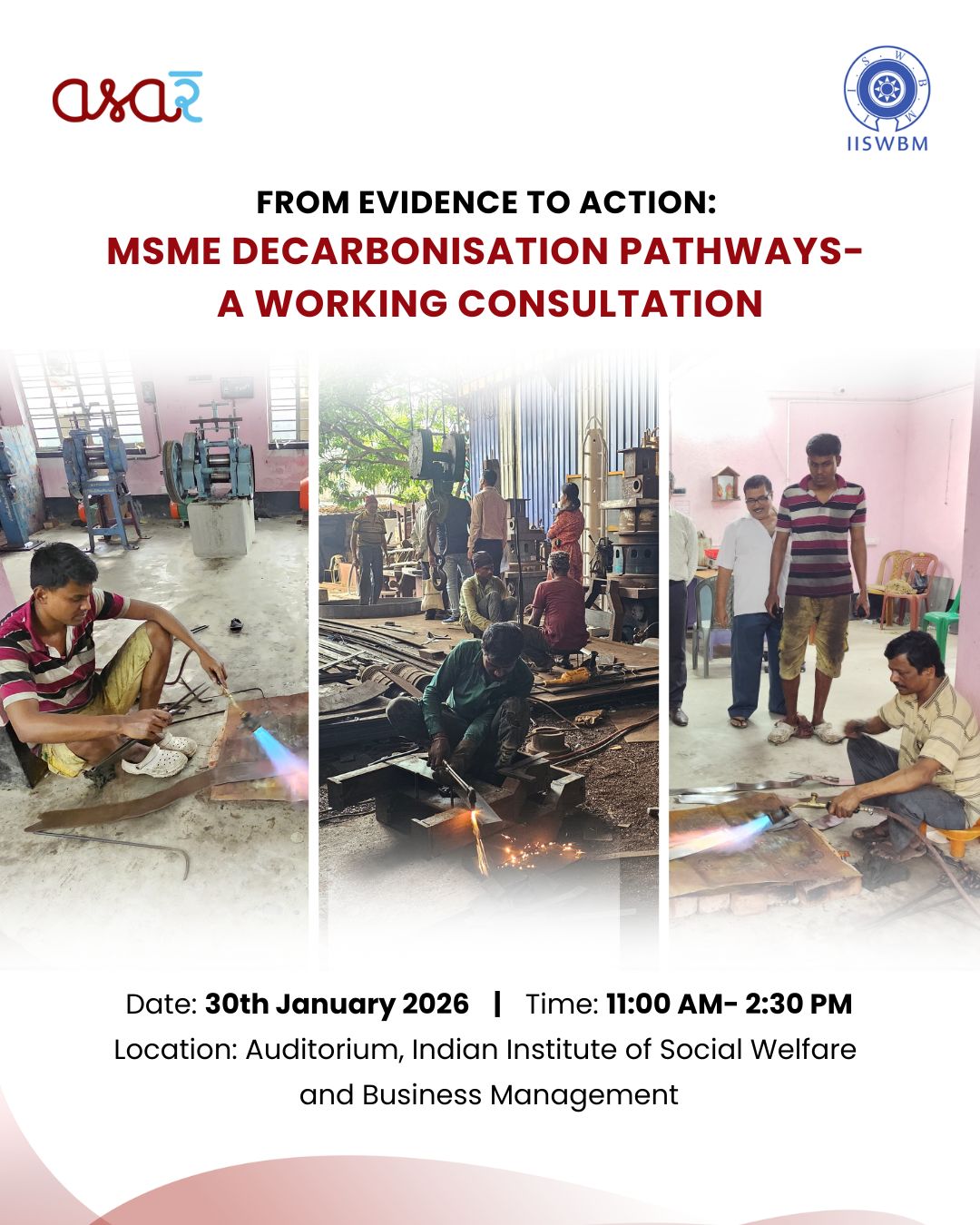
From Evidence to Action: MSME Decarbonization Pathways – A Working Consultation

Micro, Small and Medium Enterprises (MSMEs) form the backbone of West Bengal’s industrial economy, anchoring employment, exports, and local livelihoods. Micro-enterprises alone account for nearly 99% of the state’s MSMEs, often operating in dense, geographically concentrated clusters that share skills, supply chains, and production ecosystems. While these clusters sustain economic activity and preserve industrial and artisanal heritage, they also face rising energy costs, outdated technologies, and growing exposure to climate and market risks.

To address these challenges, Asar Social Impact Advisors, in partnership with the Indian Institute of Social Welfare and Business Management (IISWBM), undertook an energy assessment across selected MSME micro-clusters in Howrah and South 24 Parganas. The study covered galvanising, engineering, wire drawing, and the heritage silver filigree cluster, assessing 15 representative units to understand energy use patterns, identify inefficiencies, and highlight practical decarbonisation pathways.

The assessment brought to light common structural and operational challenges that shape energy use across these micro-clusters, underscoring the need for context-specific, financially viable solutions. It also highlighted the importance of building awareness, technical capacity, and access to enabling support systems so that micro-enterprises can gradually transition towards cleaner and more efficient production practices.

By focusing on micro-clusters as units of action, the initiative highlights how decentralised energy assessments can unlock scale, peer learning, and access to finance and government schemes. More importantly, it shows that MSME decarbonisation is not just a climate imperative—it is a pathway to improved productivity, resilience, and long-term competitiveness for West Bengal’s small industries.

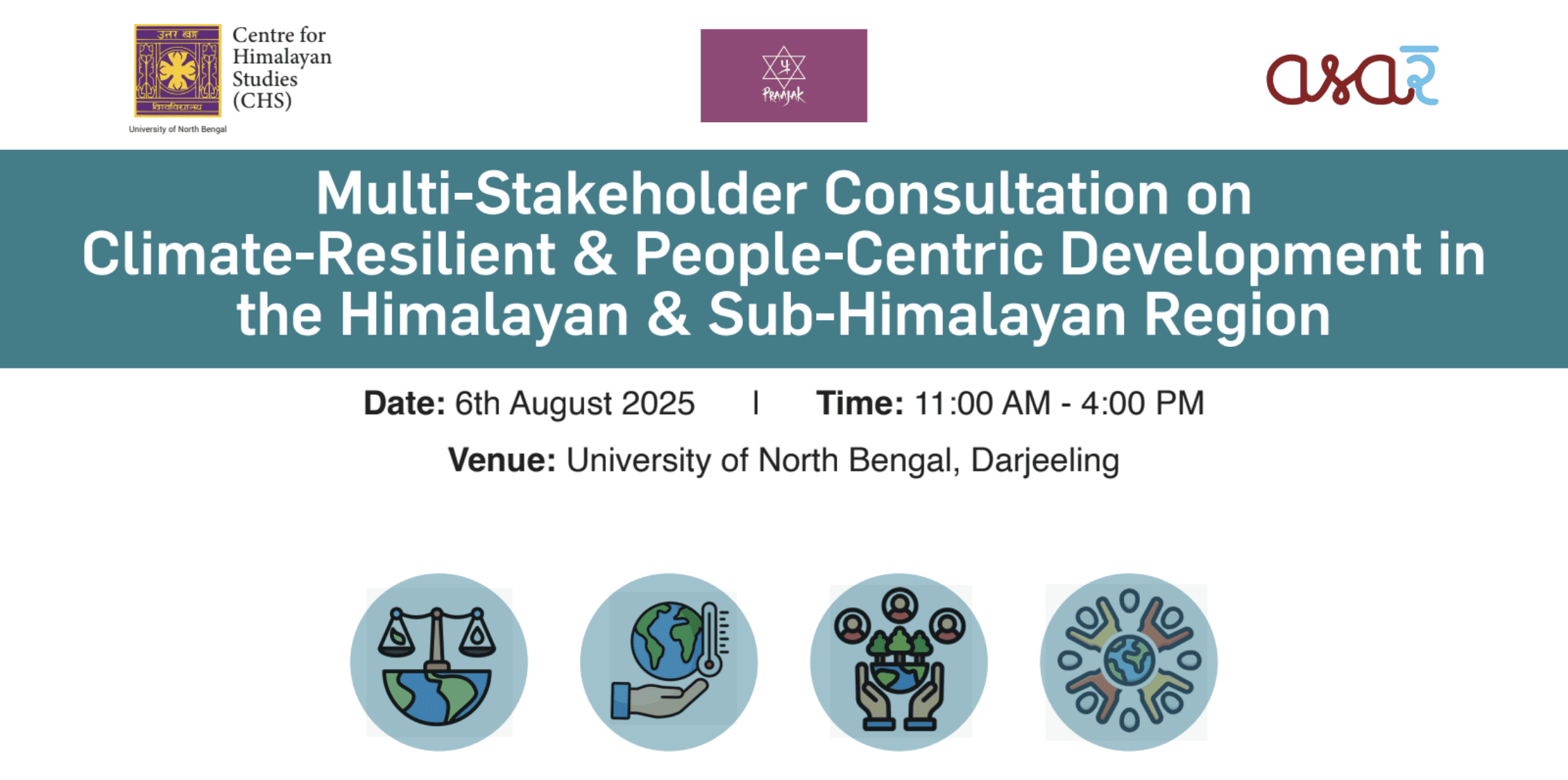
Multi-Stakeholder Consultation on Climate-Resilient and People-Centric Development in the Himalayan and Sub-Himalayan Region of West Bengal

Asar in collaboration with its local partner, Praajak Development Society, in support from University of North Bengal, is organising a Multi-Stakeholder Consultation on Climate-Resilient and People-Centric Development in the Himalayan and Sub-Himalayan Region of West Bengal. 

Given the constantly emerging climate induced vulnerabilities, the Eastern Himalayan Region and the Terai are at the immense grip of the emerging threats including altered rainfall patterns, rising temperatures, biodiversity loss, and increasing frequency of landslides and flash floods, particularly in the fragile Himalayan ecology. Traditional livelihoods such as tea cultivation, forest-based and agricultural work, and mandarin orange farming are increasingly under stress. Considering such a situation, it becomes important to focus on building a climate-resilience and climate-adaptabile model in this region, as much as it is important to look at the net-zero emissions target. 

This regional consultation is intended to initiate a discourse around climate-adaptive and people-centric alternative economy and livelihood potential for this region. 

This pivotal consultation aims to bring together a diverse set of stakeholders, including researchers, practitioners, policymakers and community leaders to engage in meaningful dialogue which will be focused around following key themes

  • Localised economic diversification, strengthening sectors like tea, mandarin orange etc while promoting complementary and climate-resilient livelihood opportunities; 
  • Community-driven pathways for climate-resilient livelihoods;
  • Policies and collaborations that ensure a just, inclusive and ecologically sustainable transition