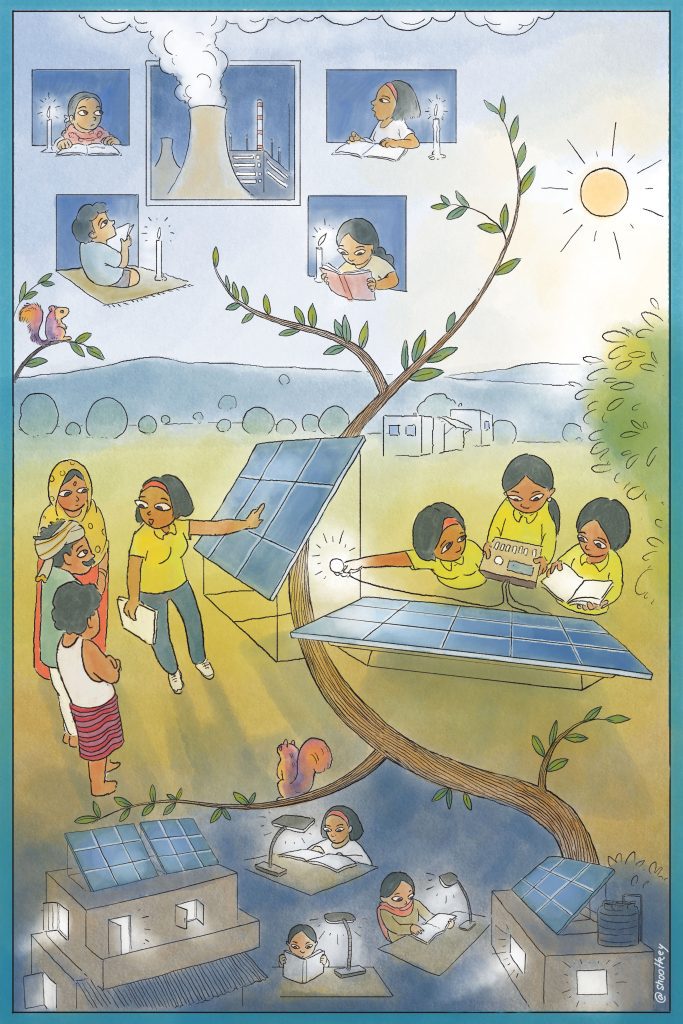
In Dantoo, a coal-belt village in Bokaro district, the climate crisis first revealed itself as darkness. During the 2021 lockdown, households received barely seven to eight hours of erratic electricity a day. Students prepared for online exams by candlelight, even as a coal-fired power plant loomed nearby. Rising heat, unpredictable rainfall and worsening air pollution only deepened the contradiction: a coal district that could not guarantee reliable, clean power to its own people.
For Aparna Kumari and a small group of teenage girls, this was a turning point. Lessons on climate change and “green skills” learned in school suddenly felt urgent and practical. If waiting for the grid meant remaining trapped between pollution and power cuts, the village would have to find its own solutions.
Illustration by: Siddhant Puryakayastha
The girls began by building confidence through vocational classes in electronics and hardware. They then connected with the National Youth Climate Consortium and a government-backed solar helper training programme at TPSDI Maithon. Returning as “solar-literate” youth, they went door to door, explaining climate change, solar energy and government schemes such as PM Surya Ghar and PM-KUSUM. With growing support from the panchayat, Aparna set an ambitious goal: to turn Dantoo into a solar village.
Today, over 30 women and young people have been trained as solar helpers. Households use solar lights and devices, reducing dependence on kerosene and candles. Several women have secured paid work with solar companies or begun repairing and assembling LED bulbs locally. Just as importantly, the initiative has shifted how the village sees its daughters, as skilled workers and climate leaders.
“Facing constant power cuts in our village, we realised waiting for the grid would not change anything,” says Aparna Kumari. “By learning solar, we are not just bringing light to our homes, we are also creating futures for our daughters.”
Receive Insights That Matter
Be the first to hear about new initiatives, community voices, and grounded climate solutions.