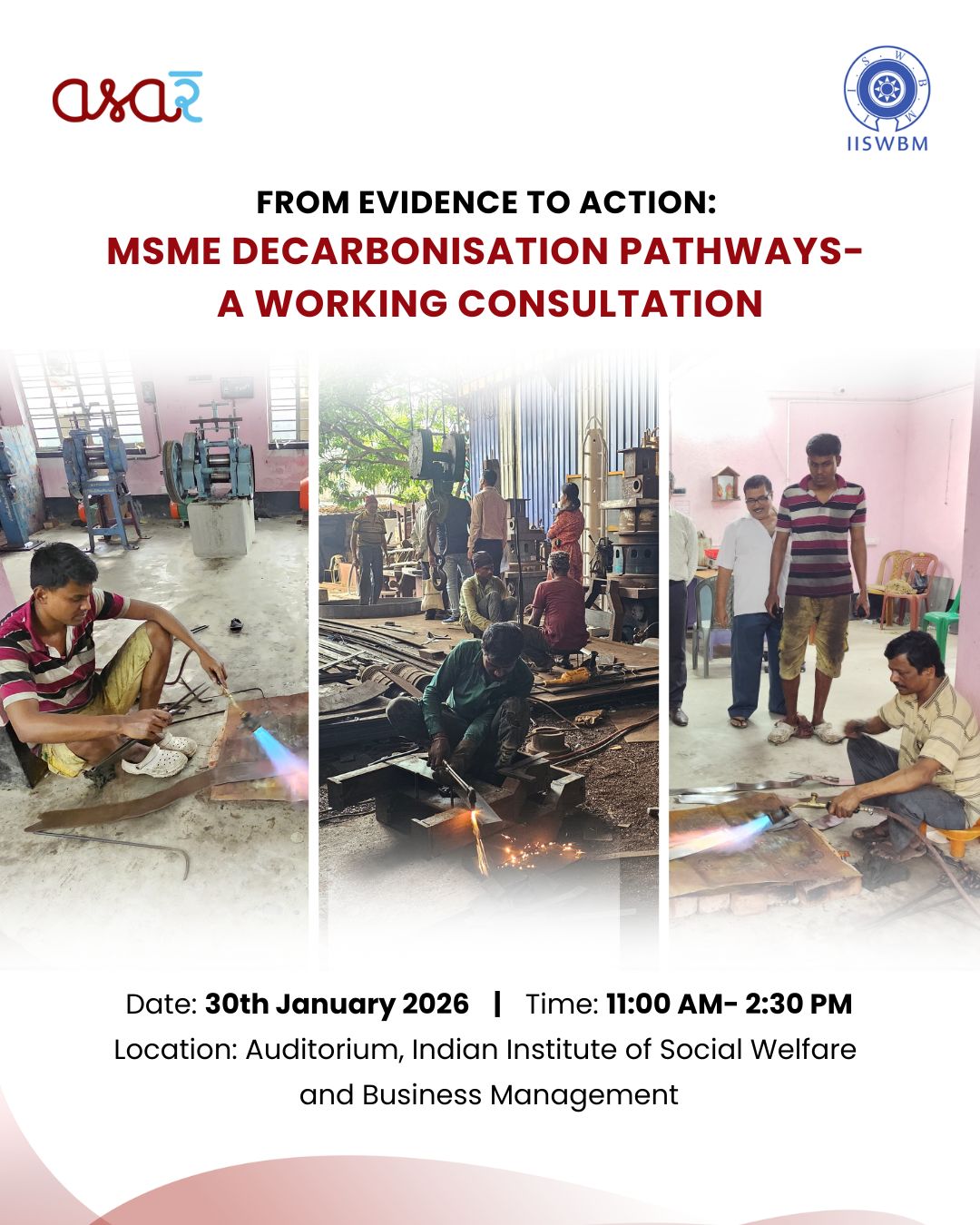
Micro, Small and Medium Enterprises (MSMEs) form the backbone of West Bengal’s industrial economy, anchoring employment, exports, and local livelihoods. Micro-enterprises alone account for nearly 99% of the state’s MSMEs, often operating in dense, geographically concentrated clusters that share skills, supply chains, and production ecosystems. While these clusters sustain economic activity and preserve industrial and artisanal heritage, they also face rising energy costs, outdated technologies, and growing exposure to climate and market risks.
To address these challenges, Asar Social Impact Advisors, in partnership with the Indian Institute of Social Welfare and Business Management (IISWBM), undertook an energy assessment across selected MSME micro-clusters in Howrah and South 24 Parganas. The study covered galvanising, engineering, wire drawing, and the heritage silver filigree cluster, assessing 15 representative units to understand energy use patterns, identify inefficiencies, and highlight practical decarbonisation pathways.
The assessment brought to light common structural and operational challenges that shape energy use across these micro-clusters, underscoring the need for context-specific, financially viable solutions. It also highlighted the importance of building awareness, technical capacity, and access to enabling support systems so that micro-enterprises can gradually transition towards cleaner and more efficient production practices.
By focusing on micro-clusters as units of action, the initiative highlights how decentralised energy assessments can unlock scale, peer learning, and access to finance and government schemes. More importantly, it shows that MSME decarbonisation is not just a climate imperative—it is a pathway to improved productivity, resilience, and long-term competitiveness for West Bengal’s small industries.