Each year, as tides rise along Kerala’s coast, fear quietly enters people’s homes. High-tide flooding is no longer an occasional inconvenience but a recurring crisis—damaging houses, contaminating drinking water, and disrupting livelihoods sustained over generations. The decline of traditional coastal agri-aqua systems such as Pokkali has further destabilised the fragile balance between land and sea.
In response, a collaborative initiative—Co-creating Community Resilience to Climate Change–Aggravated High-Tide Flooding in Coastal Kerala—emerged in 2021. EQUINOCT, Asar, and local CSOs partnered with fisher groups, farmers, and local governments to develop solutions rooted in lived realities.
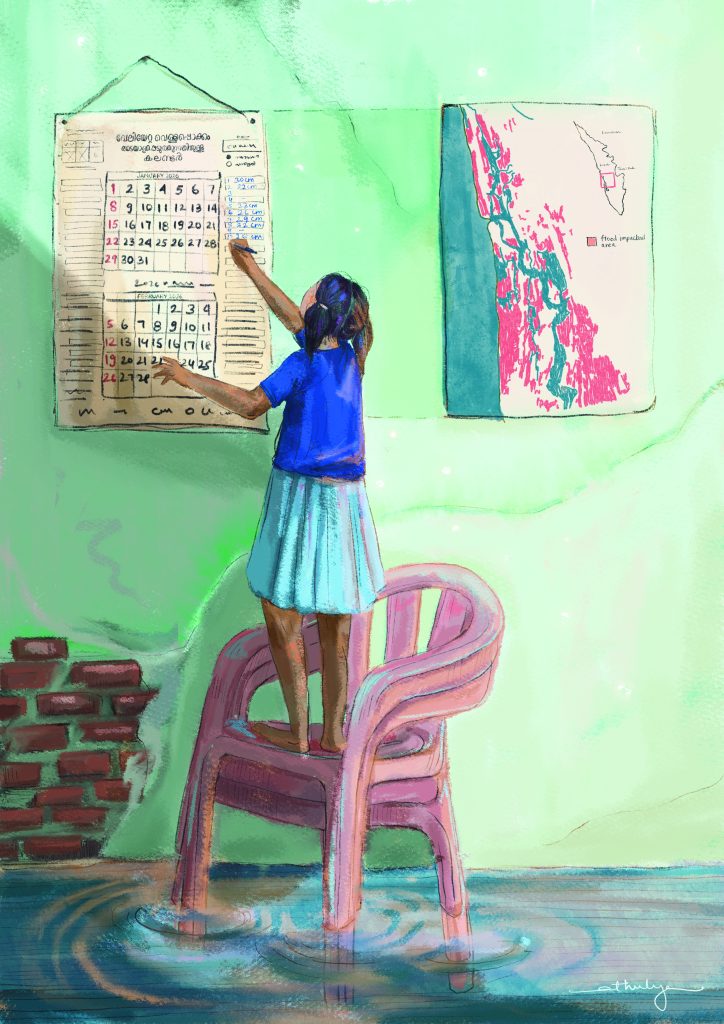
Illustration by: Athulya Pillai
“Nobody had any statistics on the extent, severity or impacts of high tide floods,” says Jayaraman Chillayill, co-founder and managing director of EQUINOCT. “So we devised a calendar, distributed across 10,000 households in 20 coastal panchayats in Ernakulam district, to record timing, water levels, and flood events. To translate this evidence into governance-ready insights, we developed SeaSight, a real-time decision-support dashboard for Panchayats and disaster management authorities.”
In September 2024, a special Gram Sabha in one of the panchayats, Ezhikkara passed a landmark resolution urging the state to recognise tidal flooding as a disaster—an action echoed by several other Panchayats. Two multi-stakeholder convenings of affected Panchayats followed. As a result of sustained efforts over five years, Kerala state cabinet recommended the inclusion of high-tide flooding as a state-specific natural disaster on 28 January 2026.
The initiative has been showcased by the Global Centre on Adaptation, the Girl Up UN Foundation, IIT Palakkad, CUSAT, and the SwitchOn SustainAgri Challenge.
Receive Insights That Matter
Be the first to hear about new initiatives, community voices, and grounded climate solutions.